Books and volumes
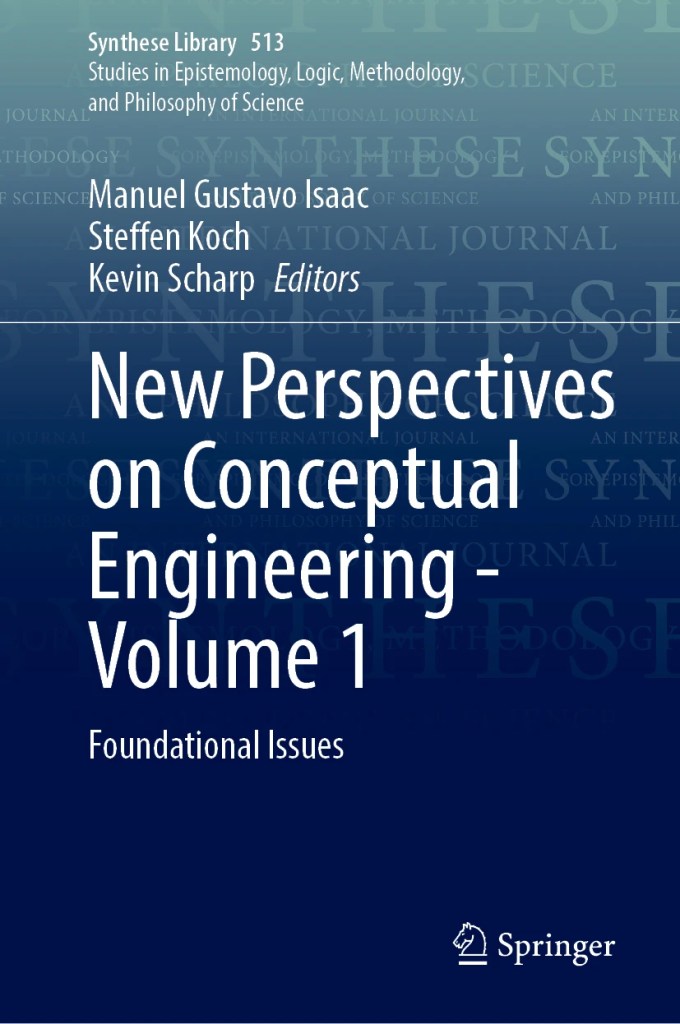
[5] Isaac, Manuel Gustavo, Koch, Steffen, & Scharp, Kevin (eds.) (2025). “New Perspectives on Conceptual Engineering” Vol. 1: Foundational Issues.” Synthese Library.
This volume is dedicated to core foundational issues in conceptual engineering: questions about the nature and varieties of conceptual engineering, whether engineering a concept necessarily preserves core features of a concept, or where the normative limits of conceptual engineering lie.
With chapters from Hans-Johan Glock, Esa Díaz León, Allison Koslow, Delia Belleri, Sarah Sawyer, Derek Ball & Bryan Pickel, Paul Egré & Cathal O’Madagain, Peter Gardener, and James Hampton.
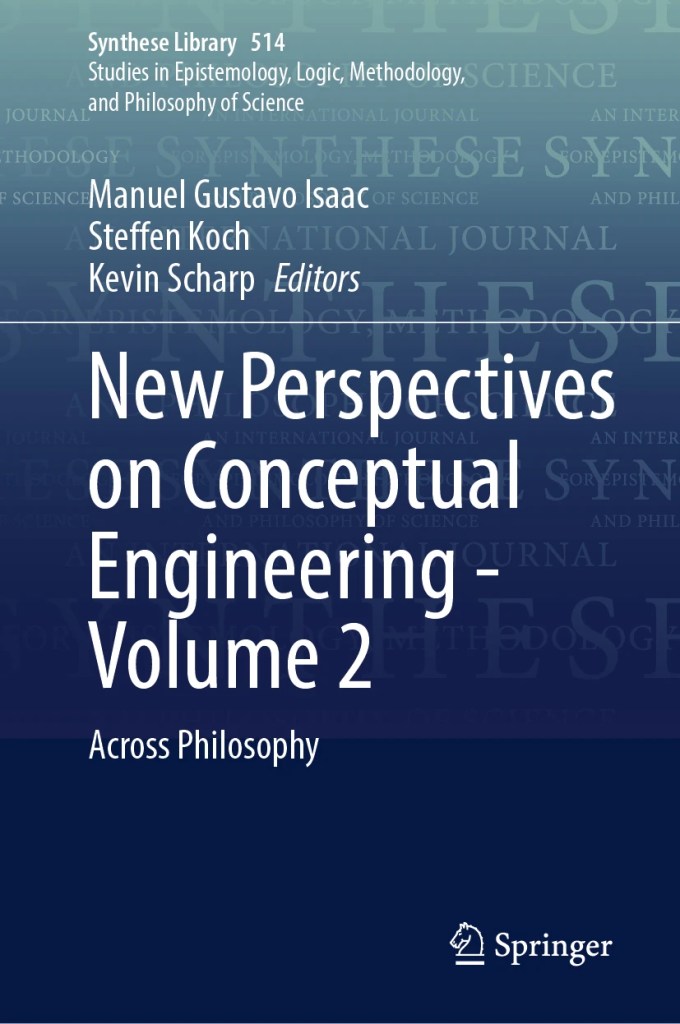
[4] Isaac, Manuel Gustavo, Koch, Steffen, & Scharp, Kevin (eds.) (2025). “New Perspectives on Conceptual Engineering” Vol. 2: Across Philosophy” Synthese Library.
This volume develops novel connections between conceptual engineering and a variety of fields and methods in analytic philosophy. It applies conceptual engineering to various philosophical questions, and explores its relation to established philosophical practices.
With chapters from Frank Jackson, Jennifer Nado, Mona Simion, Sanford Goldberg, Tristam McPherson & David Plunkett, Teresa Marques, Mari Mikkola, and Kwame Anthony Appiah.
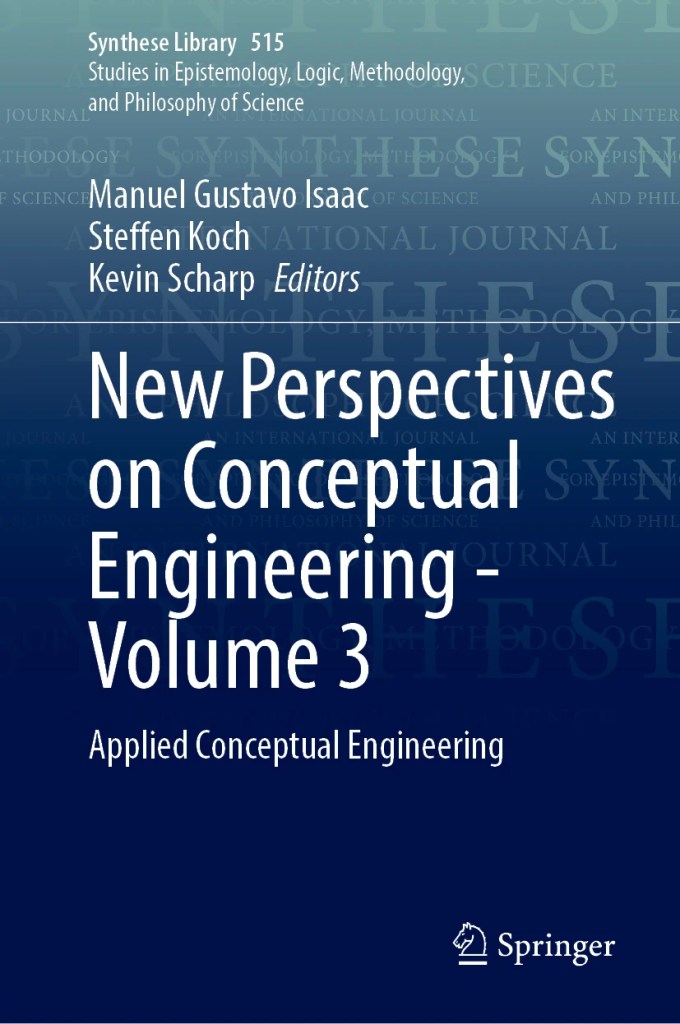
[3] Isaac, Manuel Gustavo, Koch, Steffen, & Scharp, Kevin (eds.) (2025). “New Perspectives on Conceptual Engineering” Vol. 3: Applied Conceptual Engineering.” Synthese Library.
This volume is dedicated to applications of conceptual engineering to specific cases, including medical concepts, psychiatric concepts, concepts for social groups, concepts pertaining to the COVID19 pandemic, environmental concepts, and concepts in jurisdiction.
With chapters from Ethan Landes, Rachel Cooper, Elisabetta Lalumera, Roberto Casati, Genoveva Martí & Lorena Ludeña-Ramírez, Katherine Ritchie, and Kevin Reuter & Lucien Baumgartner.

[2] Horvath, Joachim, Koch, Steffen, & Titelbaum, Michael (eds.) (2025). “Methods in Analytic Philosophy: A Primer and Guide,” Philpapers Foundation.
This reader contains brief introductions by experts to a vast variety of philosophical methods and provides links to suggested core readings.

[1] Isaac, Manuel Gustavo, & Koch, Steffen (eds.) (2022). “Foundational issues in conceptual engineering,” Special issue of Inquiry: An interdisciplinary journal of philosophy.
This special issue deals with foundational issues in conceptual engineering.
With contributions by James Andow, Delia Belleri, David Chalmers, Catarina Dutilh Novaes, Eugen Fischer, Viktoria Knoll, Edouard Machery, Amie Thomasson.
Introduction by Manuel Gustavo Isaac & Steffen Koch.
Journal articles

[21] Koch, Steffen (2025). “What does it take to establish reference in LLMs? Kripke vs. Austin” Philosophy of AI, 1, 71-76.
This is a response to Mitch Green’s response to my paper.
Against a recent trend in AI scholarship, in Koch (2025) I use a Kripke-inspired causal-historical view of reference to argue that LLMs can use names and kind terms with their usual referential properties. Green (2025), a response to Koch (2025), rejects the causal-historical account of LLM-reference and proposes an Austin-inspired alternative. This paper defends the Kripkean approach and shows that Green’s alternative is untenable.

[20] Berio, Leda, Koch, Steffen, James, Daniel, Kenyah-Damptey, Benedict, & Wiegmann, Alex (2025). “Folk concepts of race, cross-culturally,” Australasian Journal of Philosophy, 1–22.
The investigation of folk concepts of race has been central to many theoretical and experimental contributions in recent decades; however, most of these contributions have been centered around the North American cultural context. This paper provides the first cross-cultural experimental study of U.S.-American and German concepts of race. It examines whether German concepts of race are more biological than U.S.-American ones and to what extent Germans and U.S.-Americans lean towards conservationism or eliminativism about concepts of race.

[19] Koch, Steffen & Ohlhorst, Jakob (2025). “Heavy-duty conceptual engineering,” Noûs, 59(4), 902-920.
Can introducing or revising concepts through conceptual engineering go as far as expanding the realm of thinkable thoughts? Can it enable us to form beliefs, hypotheses, wishes, or desires that we are currently unable to form? We call this heavy-duty conceptual engineering. As exciting as the idea of heavy-duty conceptual enginerring sounds, it has never been developed or defended. In this paper, we offer a theory of heavy-duty conceptual engineering, distinguish it from other kinds of conceptual engineering, and show that it is possible, both in theory and in practice.
Matti Eklund responds to this paper here.
[18] Koch, Steffen (2025). “Babbling stochastic parrots? A Kripkean argument for reference in large language models,” Philosophy of AI, 1: 19-33.
Large language models (LLMs) give the impression that they know the meaning of natural language expressions and can use them productively. Recent scholarship, however, has questioned the validity of this impression, arguing that LLMs are ultimately incapable of understanding and producing meaningful texts. This paper develops a more optimistic view. Drawing on classic externalist accounts of reference, it argues that LLMs meet the conditions of successful reference by inheriting reference from their training-data.
Mitch Green responds to this paper here.

[17] Koch, Steffen (2025). “Should we stop talking about “democracy”? Conceptual abandonment and the perils of political discourse,” Asian Journal of Philosophy, 4 (28): 1-16
Herman Cappelen (2023) argues that we should abandon the concept of democracy, and hence stop using the words “democracy” and “democratic.” In the course of arguing for this claim, he also offers a general theory of conceptual abandonment. In this paper, I review and criticize both his theory of abandonment and his case for abandoning the concept of democracy.

[16] Koch, Steffen (2025). “Merely verbal agreement, speaker-meaning, and defective context,” Synthese, 205 (32).
In a merely verbal agreement, a misunderstanding between two parties creates the false impression of agreement: one or both parties think they agree on something, when in fact they do not. Unlike merely verbal disputes, merely verbal agreements have so far been ignored by philosophers. The purpose of this paper is twofold: first, to clarify what merely verbal agreement is; and second, to explore the effects of merely verbal agreement on conversational common ground, collaborative action, and academic philosophy.

[15] Koch, Steffen (2025). “Ameliorative projects, psychological essentialism, and the power of nouns,” Mind & Language, 40(3), 273-284.
Ameliorative projects advocate new linguistic content for some of our expressions. Often, they are driven by an anti-essentialist agenda that aims to undermine the idea that social categories have natural essences. But critics argue that nouns tend to trigger essentialist thinking. And because ameliorative projects typically retain nouns, these projects have a hard time achieving their anti-essentialist goals. In response, I argue that the psychological effects of noun use tend to support, rather than hinder, the anti-essentialist goals of ameliorators.

[14] Koch, Steffen, & Lupyan, Gary (2025). “What is conceptual engineering good for? The argument from nameability,” Philosophy and Phenomenological Research, 110 (2): 403-420.
Conceptual engineers think that by changing our language, we can reap all sorts of benefits, such as improving our theorizing, or combating hermeneutical injustice. But how do changes at the linguistic level translate into any of these worthwhile benefits? In this paper, we propose the nameability account as a novel answer to this question. We argue that our performance on various categorization-related tasks can be improved by making controlled changes to our linguistic resources.

[13] Koch, Steffen (2024). “The Anti-Conceptual Engineering Argument and the Problem of Implementation,” American Philosophical Quarterly, 61 (1): 73-85.
Must we overcome the implementation challenge prior to undertaking conceptual engineering? Some critics have recently answered this question affirmatively. I intend to show that they are mistaken. Successful implementation is not an integral part of conceptual engineering, and the idea that the value of conceptual engineering relies on successful implementation is in tension with widespread assumptions about normative theorizing.
[12] Koch, Steffen (2024) “How words matter. A psycholinguistic argument for meaning revision,” Mind & Language, 39 (3): 164-180.
Linguistic interventions often aim to associate existing words with new or revised meanings. But why does retaining old words matter so much? Why not instead introduce new words to express the newly defined meanings? This paper uses psycholinguistic evidence to argue that retaining a given word often has valuable consequences.

[11] Koch, Steffen, Löhr, Guido, & Pinder, Mark (2023). “Recent Work in the Theory of Conceptual Engineering,” Analysis, 83 (3): 589-603.
This survey article reconstructs the recent debate about conceptual engineering with a view to the targets and the process of engineering and provides an outlook on possible future directions.

[10] Koch, Steffen (2023). “Why conceptual engineers should not worry about topics,” Erkenntnis, 88: 2123–2143.
Many philosophers think that topics and topic continuity serve an important explanatory role in theories of conceptual engineering, namely, to determine the limits of revision. This paper argues that such limits can be understood either as the normative limits pertaining to the justification of conceptual engineering, as the metaphysical limits pertaining to the identity of the concepts in question, or as the terminological limits pertaining to usage of the original terminology. Neither of these purposes is well served by an account of topics and topic continuity.

[9] Koch, Steffen, & Wiegmann, Alex (2022). “Folk intuitions about reference change and the causal theory of reference,” Ergo, 8 (25).
In this paper, we present and discuss the findings of two experiments about reference change that are modeled on Twin Earth cases. We argue that the results provide evidence against Saul Kripke’s causal-historical view of reference, and in favor of the causal source view of reference as suggested by Gareth Evans and Michael Devitt.
[8] Koch, Steffen (2022). “Chalmers on Virtual Reality: Realism on the Cheap?,” Analysis, 82 (4): 766-774.
In his recent book, Reality+, David Chalmers argues for virtual realism – the thesis that virtual objects and events are real. This paper raises a challenge for Chalmers’ virtual realism and offers virtual fictionalism as a more promising alternative.
[7] Isaac, Manuel Gustavo, Koch, Steffen, & Neftd, Ryan (2022). “Conceptual engineering: A roadmap to practice,” Philosophy Compass, 17 (10): e12879.
This paper discusses the logical space of alternative conceptual engineering projects, with a specific focus on (1) the processes, (2) the targets and goals, and (3) the methods of such projects. We present an overview of how these three aspects interact in the contemporary literature and discuss those alternative projects that have yet to be explored based on our suggested typology.
[6] Isaac, Manuel Gustavo, & Koch, Steffen (2022). “Foundational Issues in Conceptual Engineering: Introduction and Overview,” Inquiry, 68(9), 2893–2901.
This is the introduction to the Special Issue ‘Foundational Issues in Conceptual Engineering’. The issue contains contributions by James Andow, Delia Belleri, David Chalmers, Catarina Dutilh Novaes, Eugen Fischer, Viktoria Knoll, Edouard Machery and Amie Thomasson. We, the editors, provide a brief introduction to the main topics of the issue and then summarize its contributions.
[5] Horvath, Joachim, & Koch, Steffen (2021). “Experimental philosophy and the method of cases,” Philosophy Compass, 16 (1): e12716.
In this paper, we first briefly survey the main responses to the challenge that experimental philosophy poses to the method of cases, given the common assumption that the latter is crucially based on intuitive judgments about cases. Second, we discuss two of the most popular responses in more detail: the expertise defense and the mischaracterization objection.

[4] Koch, Steffen (2021). “Engineering what? On concepts in conceptual engineering,” Synthese, 199 (1-2): 1955-1975.
Conceptual engineers aim to revise rather than describe our concepts. But what are concepts? And how does one engineer them? This paper first discusses and criticizes two influential views of this issue, before introducing the dual content view of conceptual engineering as a more promising alternative.
[3] Koch, Steffen (2021). “There is no dilemma for conceptual engineering. Reply to Max Deutsch,” Philosophical Studies, 178 (7): 2279-2291.
Max Deutsch has recently argued that conceptual engineering is stuck in a dilemma between infeasibility and triviality. This paper responds to Deutsch by arguing, first, that there is a third construal of conceptual engineering, neglected by him, which renders it both implementable and non-trivial, and second, that even the more ambitious project of changing semantic meanings is no less feasible than other normative projects we currently pursue.
Max Deutsch responds to this paper here.
[2] Koch, Steffen (2021). “The externalist challenge to conceptual engineering,” Synthese, 198 (1): 327–348. Preprint.
Semantic externalism raises doubts about the feasibility of conceptual engineering. If meanings are determined by external factors such as causal histories or microphysical structures, it seems that they cannot be changed intentionally. This paper gives an extended discussion of this ‘externalist challenge’. It argues, first, that the viability of conceptual engineering depends on our ability to bring about meaning change; and second, that we possess at least ‘collective long-range control’ over word meanings, which is sufficient to get conceptual engineering off the ground.
[1] Koch, Steffen (2019). “Carnapian explications, experimental philosophy, and fruitful concepts,” Inquiry, 62 (6): 700-717. Preprint.
It seems natural to think that Carnapian explication and experimental philosophy can go hand in hand. But what exactly explicators can gain from the data provided by experimental philosophers remains controversial. This paper defends experimental philosophy’s role in explication preparation against recent criticism by Mark Pinder and outlines some problems for his account of how experimental philosophy can feature in assessing the likelihood of uptake.
Reviews
[1] Koch, Steffen (2019). “Herman Cappelen. Fixing Language. An Essay on Conceptual Engineering” (review), Logical Analysis and History of Philosophy. Preprint.
This paper critically discusses Herman Cappelen’s book Fixing Language.
Book chapters

[5] Koch, Steffen, & Nimtz, Christian (forthcoming). “Themen metaphilosophischer Forschung: Conceptual Engineering,” In: Lewin, Michael, & Minkin, J. B. Metzler.
[4] Koch, Steffen (2025). “Conceptual Engineering: A brief Introduction,” in: Horvath, J., Koch, St., Titelbaum, M. (editors). Methods in Analytic Philosophy: A Primer and Guide. PhilPapers Foundation.
This paper offers a brief introduction to the field of conceptual engineering along with some hyperlinked readings and an annotated reading bibliography.
[3] Briesen, Jochen, & Koch, Steffen (2023). “Conceptual Infrastructure and Conceptual Engineering,” in: Aaron Pinnix, Axel Volmar, Fernando Esposito, & Nora Binder (eds.), Rethinking Infrastructure Across the Humanities, Transcript.
This paper develops the idea that language is a kind of infrastructure and that doing conceptual engineering is to maintain this infrastructure.

[2] Koch, Steffen (2022). “Conceptual Engineering. Begriffe auf dem Prüfstand,” in: Niklas Grouls and Laura Martena (eds.), Anspruch und Methode der Philosophie. Stimmen aus der Gegenwart, WBG.
Dieser Artikel erläutert die grundsätzliche Motivation des Conceptual Engineering und diskutiert außerdem einige der wichtigsten Probleme und Perspektiven dieses noch äußerst jungen und aufregenden Forschungsfeldes.

[1] Koch, Steffen (2019). “Reliabilismus,” in: Martin Grajner & Guido Melchior (eds.), Handbuch Erkenntnistheorie, Metzler, pp. 169-178. Preprint.
This is a survey article about reliabilism. It introduces its main ideas, outlines some of its core challenges and discusses a number of solutions.
Non-academic publications

[3] Koch, Steffen (2025). “Trump und die ‘woke Sprachpolizei’: Alles nur Sprachmagie?,” praefaktisch philosophy blog: https://praefaktisch.de/002e/trump-und-die-woke-sprachpolizei-alles-nur-sprachmagie/
Image by Gage Skidmore.

[2] Koch, Steffen (2025). “Merely verbal agreement, in philosophy and beyond,” New work in philosophy blog: https://newworkinphilosophy.substack.com/p/steffen-koch-university-of-bielefeld

[1] Koch, Steffen. “Ein Rassismus ohne Rassisten?,” Frankfurter Allgemeine Zeitung, June 24, 2020.
Work in progress (different stages)
- A monograph on linguistic interventions [in preparation; four chapters written]
- A paper on philosophical methodology (joint work) [under review]
- A paper on the cognitive roots of the problem of free will (joint work) [under review]
- A paper on how conceptual engineering transforms philosophical methodology (joint work) [under review]
- A paper on semantic intentions (joint work) [under review]
- A comment on Viktoria Knoll’s “Bloße Streite um Worte”
- An experimental philosophy paper on whether “Rasse” is slur-like (joint work) [in preparation]
- A paper on merely verbal agreement and disagreement (joint work) [in preparation]
- A paper on whether we get our concepts from language (joint work) [in preparation]
- A paper on strategic underspecification and merely verbal agreement (joint work) [in preparation]
 Steffen Koch